Golf Green at Home: What Makes a Green Challenging
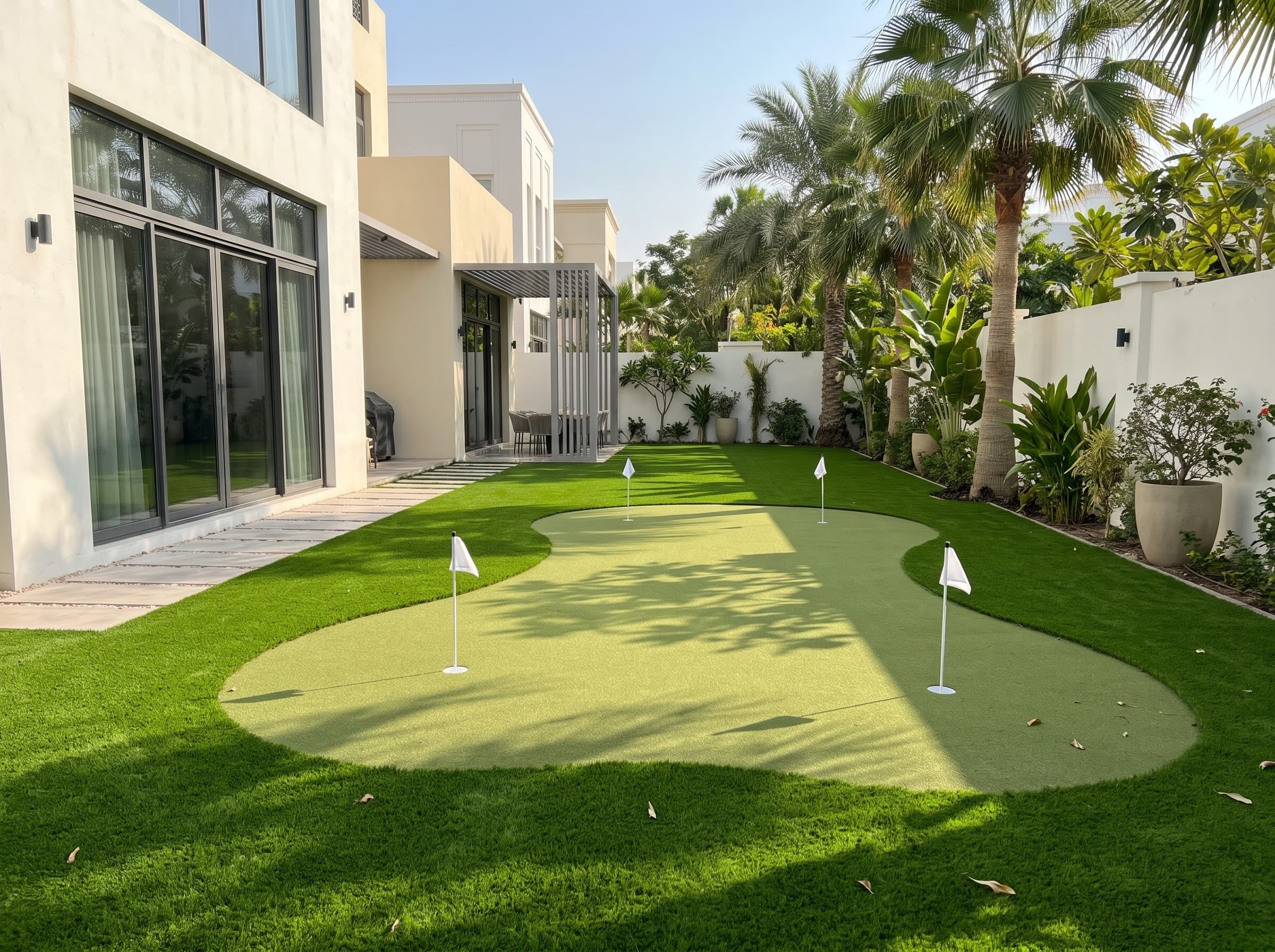
A flat green is easy to build and quickly forgotten. What keeps a golfer coming back to a golf green at home is the challenge: putts that break, slopes that punish the wrong pace, a chip that has to land on the right spot. These features have names in golf architecture, and each one trains a different part of the short game.
This article explains the features that make a golf green difficult, in the language golf course architects use, and how they translate to a private green in a villa garden.
Slope and Break: The Foundation
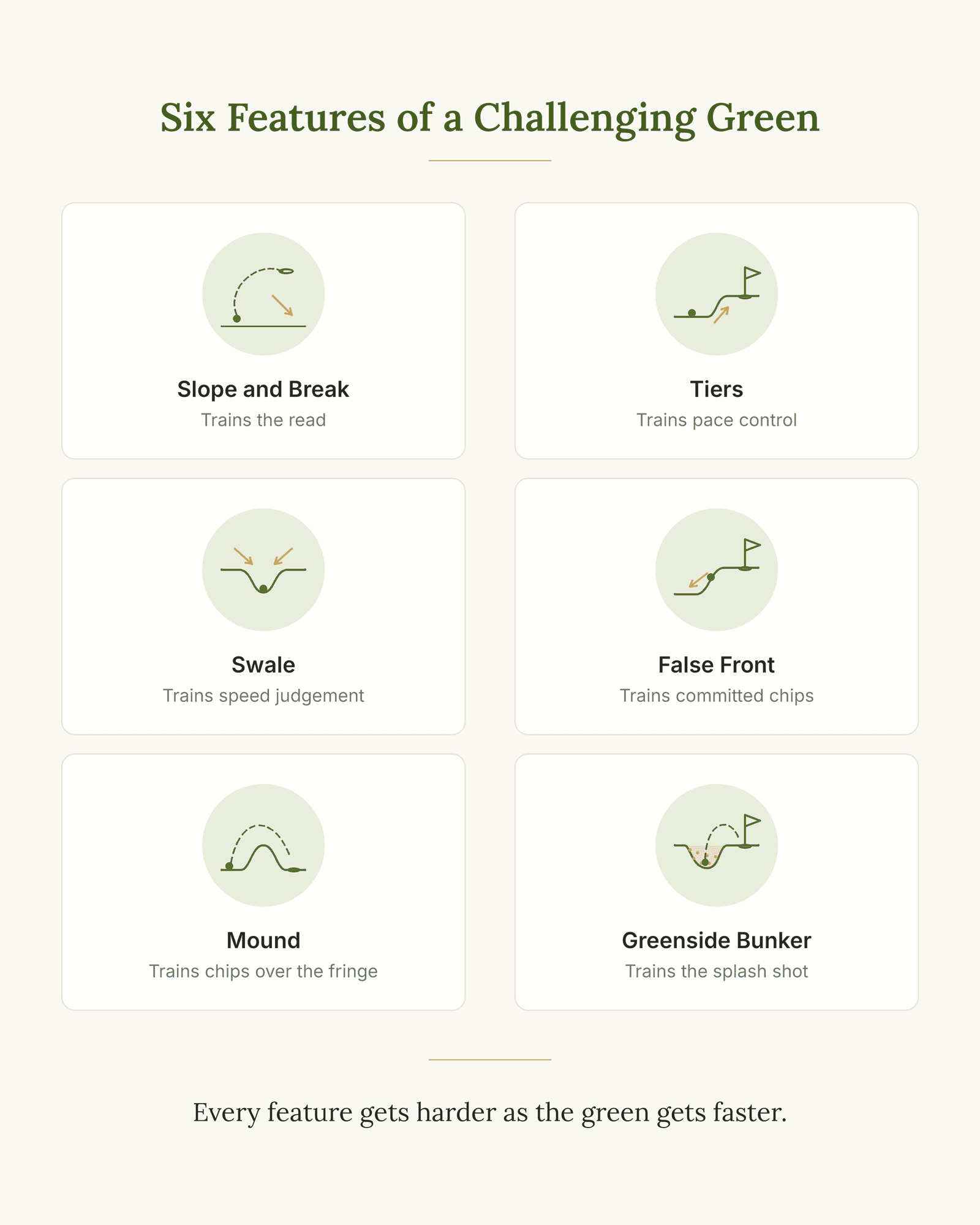
Slope is the tilt of the putting surface. Break is what the slope does to the ball: the curve it takes as it rolls. Reading the break means judging both the direction and the amount of curve, and the two depend on pace. A firm putt breaks less, a gentle putt breaks more.
On a golf green at home, gentle slopes are what turn practice into a game. Every putt asks a question before it is struck: where to aim, and how hard to hit.
Tiers: Two Levels, One Green
A tier is a distinct level of the green, joined to another by a steeper slope. Putting from one tier to another is one of the hardest putts in golf: uphill, the ball must be struck firmly enough to climb and still stop near the hole; downhill, a putt struck with normal pace runs well past.
In JLT, a family green grew during the build into an L-shaped green of about 64 m² across three tiers with six holes. On Yas Island, a green of about 60 m² is built on two tiers with the higher level at the centre, so putts break away from the middle in every direction.
Crowns, Ridges and Plateaus
A crowned green, sometimes called a turtleback, is highest in the middle and falls away on all sides. A ball that misses the crown rolls off towards the edges. A ridge, or spine, divides a green into two sections: the same hole plays completely differently depending on which side the ball starts. A plateau, or shelf, is a raised, flatter area where a hole can sit, surrounded by slopes that test the approach and the first putt.
These features multiply the variety of putts without adding a single square metre.
Swales, Hollows and Mounds
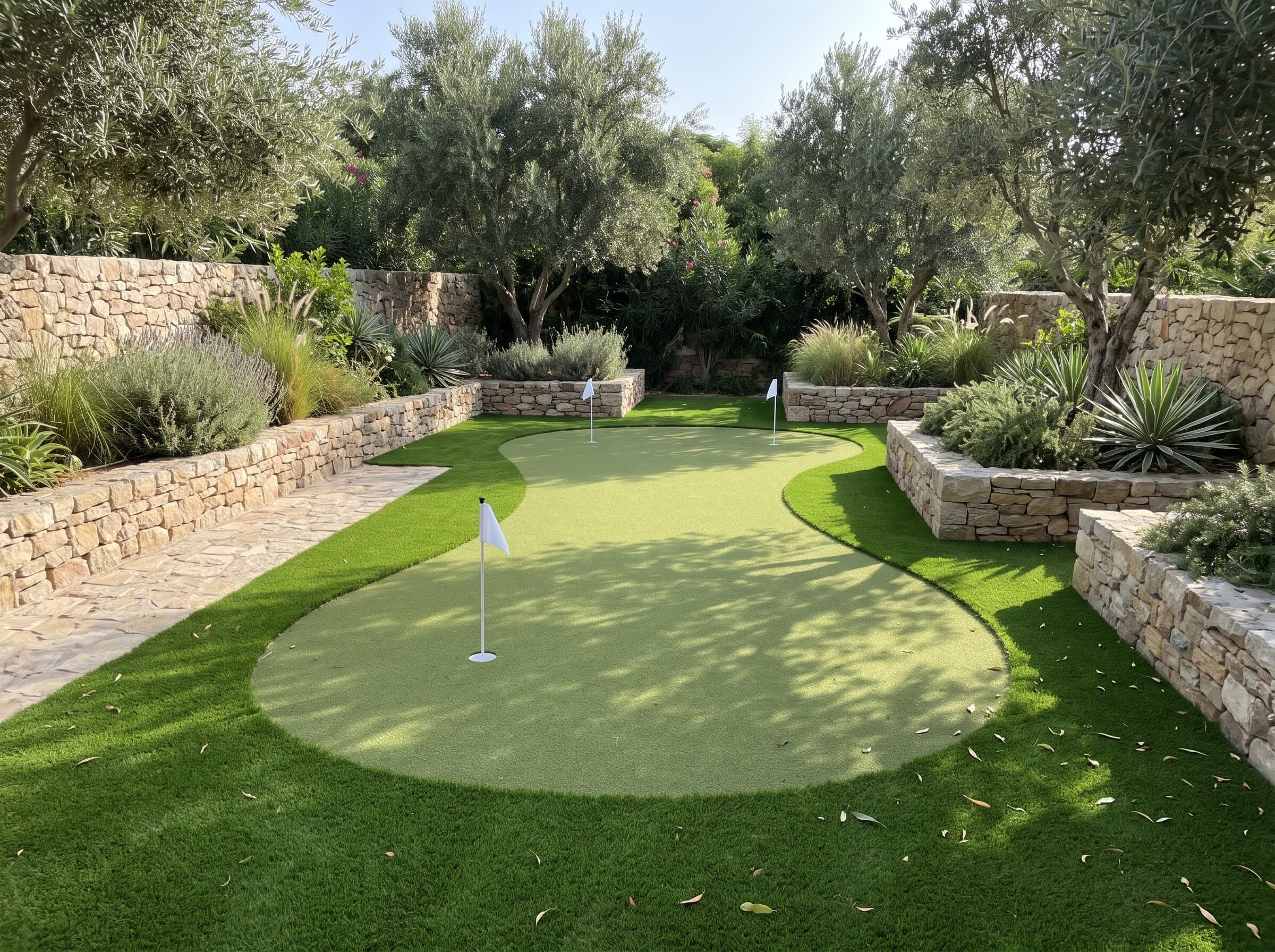
A swale is a shallow, open depression running across or beside a green. A ball rolling through it slows down, speeds up or changes line, which makes the pace almost impossible to judge without practice. A hollow is a smaller depression, often beside the green, that collects missed approach shots and leaves a delicate chip or putt back up the slope.
A mound works the other way: a raised hump that deflects the ball, guards a hole or frames the green. Mounds around a green also shape the chips played from the fringe, since the ball must carry or climb them.
False Fronts
A false front is a slope at the front edge of the green that rejects any approach that comes up short: the ball lands, then rolls back off the green, down to the fringe or into a hollow. It is one of the most demanding features in golf, because it punishes a chip that is only slightly too soft. On a home golf green with a chipping area, a false front turns every short approach into a test of commitment.
Greenside Bunkers
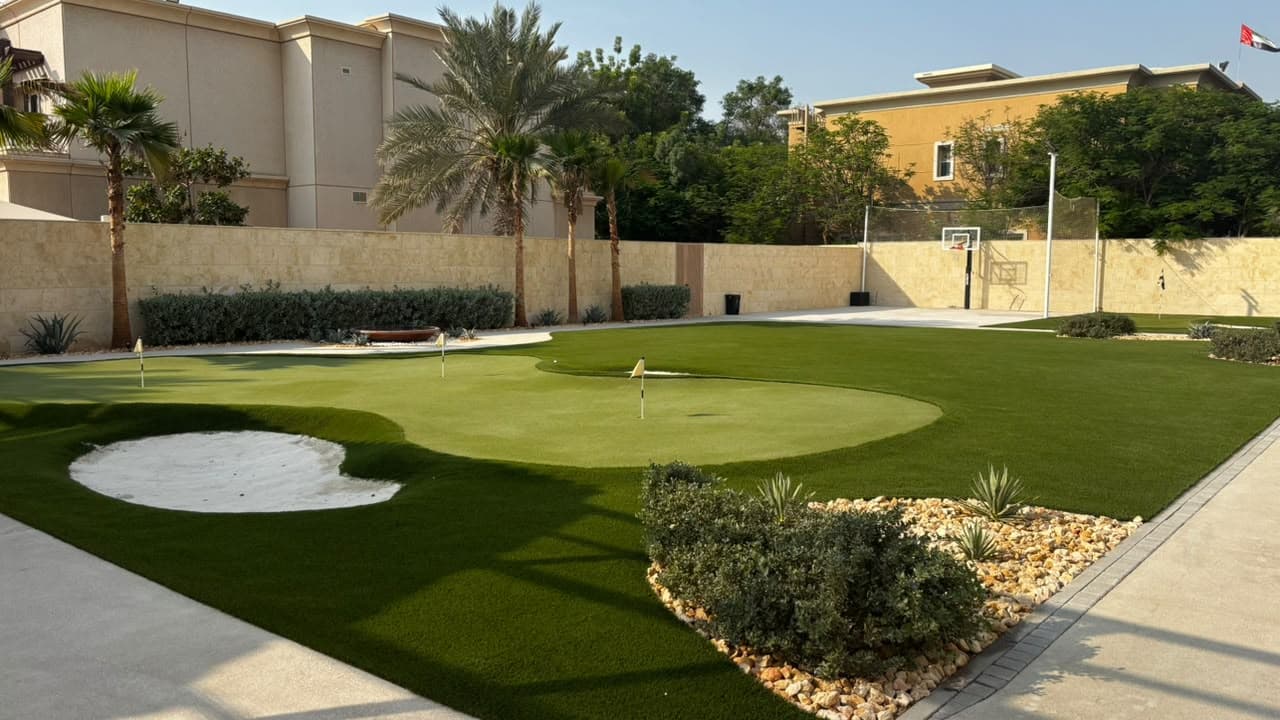
A greenside bunker adds the one shot a putting surface cannot train: the splash shot, where the club enters the sand behind the ball and the sand carries it out. It is one of the most feared shots for amateur golfers, and one of the least practised. A bunker beside the green also changes the chips around it, since a ball must carry the sand before it lands. On Yas Island, a small bunker is integrated into the green, and in Al Mizhar, three bunkers surround a green and a target green 30 metres away. A bunker can always be added later to a green we created.
Pin Positions: Changing the Green Every Day
On a golf course, the pin position changes the green from one day to the next. A hole on a plateau, behind a ridge or just over a false front plays very differently from a hole on a flat area. On a golf green at home, several holes spread across the contours give the same effect: the golfer chooses the challenge by choosing the hole.
Speed: The Feature That Amplifies All the Others
Every feature above becomes harder as the green gets faster. A slope that is gentle at a slow pace becomes a severe break on a fast green, and a downhill putt from one tier to another can become almost impossible to stop. On our putting system, a 16mm specialist putting turf with approximately 7kg of silica sand per m², the speed can be adjusted after installation by adding or reducing silica sand. The green can be set gentler for a family, or quicker for a golfer who plays fast club greens. We explain what controls the roll in The Science of True Ball Roll.
Designing a Golf Green at Home With the Right Difficulty
A private golf green should challenge its owner without frustrating the rest of the family. The right mix depends on who plays:
- A family green needs flatter areas and gentle breaks, with one or two harder holes for the keen golfer.
- A serious golfer's green can combine tiers, swales, a false front and a bunker, with holes placed to test every distance.
- A green seen from the house must also look right: contours that read as natural landscape, not as a technical surface.
Every Riviera Grass green is bespoke. The owner receives a plan showing the number of holes, the elevations and the position of the slopes, and every contour is shaped by hand on site, so a new idea can still be integrated up to the last minute. Every installation is carried out by our own team, run hands-on by the three founders.
Your Golf Green at Home
Tell us how you play and how much challenge you want. Discover our private putting greens and our putting greens in Dubai, browse our villa putting green ideas, then request a private consultation, free and without commitment. A Riviera Grass specialist will usually reach out within two hours.
Frequently asked questions
- Can I have a real golf green at home?
- Yes. A synthetic golf green is built in the garden on a levelled base, with holes, slopes and tiers shaped by hand, and it plays like a putting green at the club.
- What is a break on a golf green?
- The curve the ball takes as it rolls across a slope. Its amount depends on the slope and on the pace of the putt.
- What is a false front?
- A slope at the front of the green that sends a short approach rolling back off the green.
- What is a swale?
- A shallow depression across or beside a green that changes the speed and line of the ball as it rolls through.
- Can a home golf green have tiers and a bunker?
- Yes. Our Yas Island green combines two tiers with a small integrated bunker, and our JLT green has three tiers.
- Can the difficulty be adjusted later?
- The speed can. On our putting system, it is adjusted by adding or reducing silica sand, which makes every slope and break more or less demanding.
Ready to talk about your own green?
Share a few details and a Riviera Grass specialist will usually reach out within two hours.